


"To do our work, we all have to read a mass of papers.
Nearly all of them are far too long.
This wastes time, while energy has to be spent in looking for the essential points."
Churchill was well known as a great orator. He also spent hours reading vast numbers of reports from his cabinet, his commanders, and his advisors. He wanted to be across all the detail, but the length and writing style of these reports were getting in the way.
He couldn't efficiently access the information he needed to know. He couldn't make informed decisions fast enough.
Churchill being Churchill, he cut to the chase. On 9th August 1940, he wrote a memo to the War Cabinet titled ‘BREVITY’:
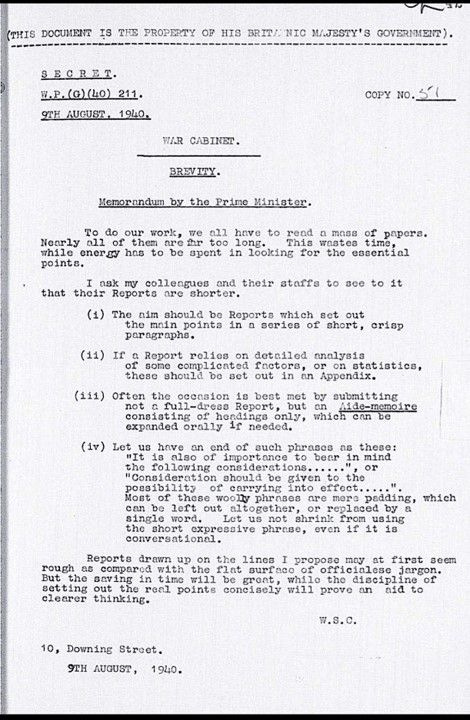
To summarise Churchill's four requests:
Set-out the main points in a series of short, crisp paragraphs.
Place detailed analysis in an appendix.
Consider just an aide-mémoire of headings and expand on them orally.
Remove cumbersome prose and woolly phrases.
His goal was to save time, but he also nailed another critical benefit when he wrote:
“The discipline of setting out the real points concisely will prove an aid to clearer thinking.”
How true that is. Writing a shorter note, to paraphrase Blaise Pascal, takes time. That is because it requires more thought to identify the key points and summarise them well.
What does this mean for consultants today?
Churchill wrote ‘BREVITY’ forty-five years before Barbara Minto published similar guidance on structured thinking in The Pyramid Principle, and neither of them had experienced the impact of the digital world.
In their day, the manual effort of producing hand-typed memos or hand-drawn acetate slides at least provided some restraint to volume, but PowerPoint, AI, and the rest have removed those guardrails. It has never been easier to assemble an impressive-looking document, with polished prose, tidy structure, and a confident tone, without doing the underlying work of deciding what truly matters.
The decisions made off the back of such documents will be the worse for it.
Consultants must continue to develop the ability to think well and communicate succinctly. More so than ever, as structured thinking and clear writing become increasingly under-developed skills in a generation willing to outsource the impression of them to AI.
Producing a report is very, very easy. Producing a well-written report that is crystal clear is rare…and valuable.
Exploring Data vs Explaining Data
I’ll leave you with a concept from an excellent book, ‘storytelling with data’ by Cole Nussbaumer Knaflic. In it, she makes a distinction between Exploring data and Explaining data.
When you're in an Exploring mode, you talk about the journey. You share everything you've discovered. You are enjoying the data for the sake of the data. There is a place for that, often early in a project, when the answer is not yet clear.
When you're in a mindset of Explaining, you are helping others make a decision. You are focused on the questions they have and the actions they can take.
As a consultant communicating with clients you almost always want to be in the Explaining mode. That's how you can help them make decisions.
Pair Knaflic's distinction with Churchill's four rules and you have a useful working method for your communication:
Open with a clear summary that explains the key points they need to understand.
Expand on each with a series of short, crisp paragraphs or a single powerful chart.
Place detailed analysis in an appendix.
Reduce word count, remove padding, eliminate cumbersome prose.
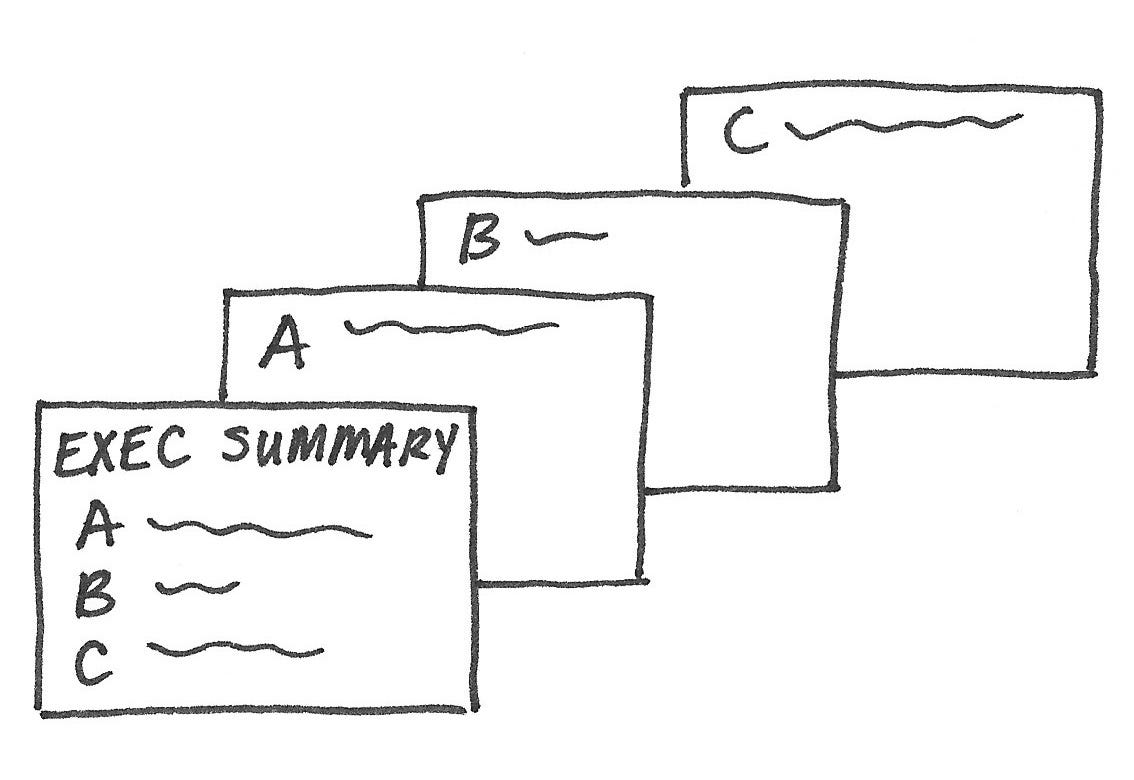
It is not a complicated method, but its success relies on you deciding what matters before you start writing (or prompting!).
The acid test: Can a busy reader leave the first page with a clear understanding of the critical information they need to make a decision?
If yes, the thinking has been done. Get that right and brevity will follow.
Thank you for reading The Skilled Consultant. If you haven’t yet subscribed, please do so to receive all our articles direct to your inbox.
There are several other ways you can interact with Honeycomb Consulting Skills Training….
Connect with Deri Hughes (Founder & MD) on LinkedIn
Connect with Colin Mann (MD) on LinkedIn
Book a 30 minute intro call with Deri Hughes
Book a 30 minute intro call with Colin Mann
Stay informed about our free workshops and webinars - follow Honeycomb on LinkedIn or visit our website.
💯 This reminds me of a comment by US President Woodrow Wilson when asked about the time he needed to prepare a speech: “If it is a ten-minute speech, it takes me all of two weeks to prepare it; if it is a half-hour speech, it takes me a week; if I can talk as long as I want to, it requires no preparation at all. I am ready now.”