


A warm welcome to kieran sheedy, our guest author this week. Kieran is a seasoned management consultant and entrepreneur who has held senior roles at IBM and KPMG, leading strategic change programmes. This month he published a book - The Thinking Fix: Rewire thinking patterns for better results - with Honeycomb MD Deri Hughes.
Should boutique consultancies be panicking? Either because AI will destroy their business or because they haven’t yet got their resources ready for the AI adoption boom?
The answer is classic consulting – ‘it depends’. More specifically, it depends on whether your offer includes change implementation.
Leading voices like Harvard Business Review (HBR), McKinsey & Company, Boston Consulting Group (BCG), and the Financial Times (FT) consistently reach the same conclusion: AI implementation is fundamentally a behavioural and operational change problem, not a technology problem.
Treating AI as a plug-and-play IT purchase is the leading reason corporate AI initiatives fail to deliver their ROI.
The 10–20–70 Rule
BCG and MIT Sloan Management Review analysed enterprise AI transformations and formulated what is a widely accepted benchmark across management consulting:
10% of the effort is building tailored AI solutions.
20% is setting up technology and data infrastructure.
70% is business process transformation and change management (people, culture, incentive structures, and workflows).
Without investing heavily in the 70%, organisations experience ‘pilot paralysis’. That is where AI works in a test environment but fails to generate bottom-line value when integrated into real-world operations.
Other opinions are pretty consistent:
Harvard Business Review: AI Isn’t Magic
HBR research confirms that buying fancy software won’t magically fix broken processes (often called ‘technosolutionism). Unsurprisingly, human trust fails when staff suspect the new tech is out for their jobs. Culture eats AI for breakfast; adoption requires real employee buy-in and upskilling. HBR writers Thomas Davenport and Rajeev Ronanki stress that top-ROI firms don’t just automate old habits, they completely redesign workflows to free up human talent.
McKinsey: Match the Tech Budget
McKinsey’s Rewired offers a simple, if sobering, rule: for every $1 you spend on AI tech, budget $1 for change management, retraining, and process updates. Their research shows the real winners (300%–500% ROI) rewrite the organisational playbook rather than just buy expensive software licenses.
Financial Times: The Human Bottleneck
The Financial Times notes a classic ‘productivity paradox’: companies are pouring billions into AI, yet output remains flat. Don’t blame the tech. It’s rarely hallucinations and rogue AI agents. It’s middle-management anxiety and workforce suspicion leading to sabotage, to ‘malicious compliance.’ Without clear leadership and a compelling, personal, benefits case, reasonable staff will see AI as a threat rather than a helpful sidekick.
This is not a new problem
It is just like every other technology-driven change we have seen. It started with the spreadsheet, then from the SAP and Oracle ERP installs and overhauls, and cloud migrations, to the adoption of SaaS like Salesforce, the technology itself is only the ticket to the game. The real win comes down to whether the organisation and the people actually change how they work to deliver the benefits.
So what can be done?
In conversations with business leaders we can point out the gaps below.
This gives them the opportunity to get the focus right.
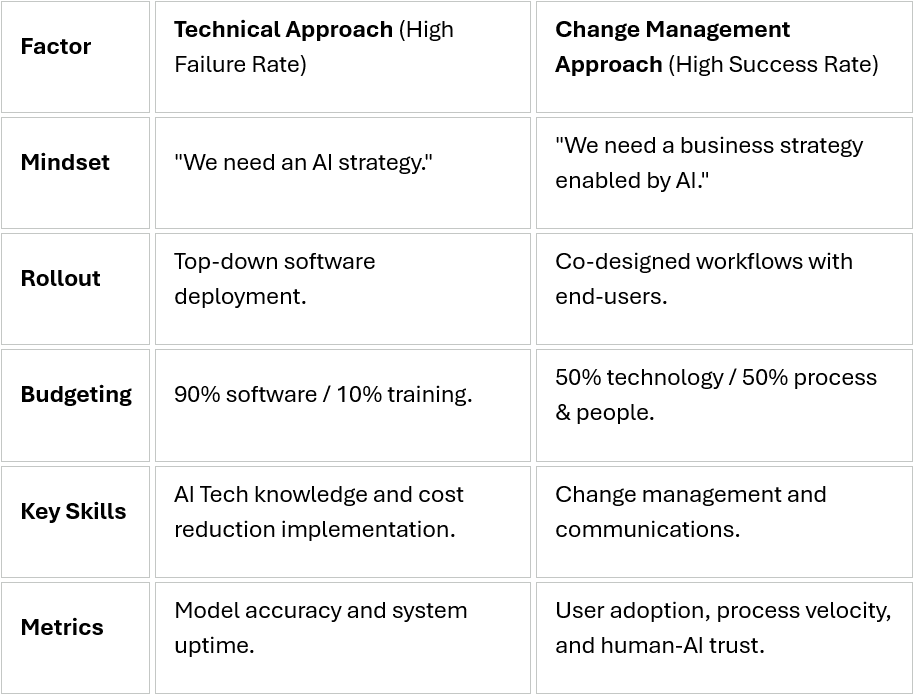
Many consulting firms have treated the change management skills your team uses in every assignment as a background skill. Something that does not differentiate you the way your industry specific skills do. If so, a change of emphasis might be timely.
Maybe you don’t typically have direct responsibility to implement the changes your work recommends. Despite this, when you deliver your proposal and benefits case, you will take account of the need to engage and persuade the client team that needs to make that change. Pay attention to your ability to promote change, and draw attention to it.
Invest in change management skills
Your experienced team already has good people skills. How do you know this? They are effective consultants, it is a ‘minimum to play’. However, these skills are even more important in the adoption stage of AI. They need to be developed and promoted to clients.
You could do worse than get your team and your clients to read ‘The Thinking Fix: Rewire thinking patterns for better outcomes’ (published by Pearson this autumn.) Am I biased? Yes I am, I’m one of the authors. But it is a useful hand-book explaining how people think, how they react to change, and how to manage their reactions for better results.
Whatever you do, embrace this change. AI adoption is primarily a technology-led change management problem. Many good consultants already have a lot of skills and experience in this area. Alert your clients to the importance of investing in the change and make it crystal clear that you have the chops for this.
Thank you for reading The Skilled Consultant. If you haven’t yet subscribed, please do so to receive all our articles direct to your inbox.
There are several other ways you can interact with Honeycomb Consulting Skills Training….
Connect with Deri Hughes (Founder & MD) on LinkedIn
Connect with Colin Mann (MD) on LinkedIn
Book a 30 minute intro call with Deri Hughes
Book a 30 minute intro call with Colin Mann
Stay informed about our free workshops and webinars - follow Honeycomb on LinkedIn or visit our website.