

We regularly have clients approach us with a common ambition. They’ve got a superb team of technical experts - software developers, scientists, or engineers. Often they’ve come from industry roles and are now supporting clients to solve the same types of problems as consultants.
So what’s the ambition the leaders of these teams have?
They want to change the way these experts engage with clients. To shift from ‘expert’ to ‘consultant’ and then to ‘trusted advisor’. Typically that means getting their heads up from the detail, understanding the commercial context clients operate in, and building relationships that go beyond the technical. It means making more strategic recommendations to more senior people. Ultimately, it means influencing the direction of bigger programmes of work and being trusted with earlier stage conversations and longer-term planning.
And some of these team leaders have even loftier ambitions. They want their technical folks to go further than just ‘trusted advisor’, to get to…
(whisper it quietly or you’ll scare them off)
…‘sales person’
How can we tell this is a scary topic? Because “Sales” frequently gets rebranded to “BD”. In fact, the very word can provoke a reaction like saying someone saying “Voldemort” at the Leaky Cauldron pub.
It’s a perfectly understandable goal. These are high-performing experts doing exceptional technical work who have deep trust from their clients. Clients who often come back wanting more, even without the consultant proactively driving sales. Their leaders see the potential to do even more, even bigger, even better work with those clients - if only these technical folks would start shifting more towards being sales people.
But, that ambition often runs into resistance. And for good reason.
What gets in the way?
I asked the question below in a LinkedIn poll recently. The majority felt that this transition was entirely possible, particularly for someone whose personality is naturally suited to sales.
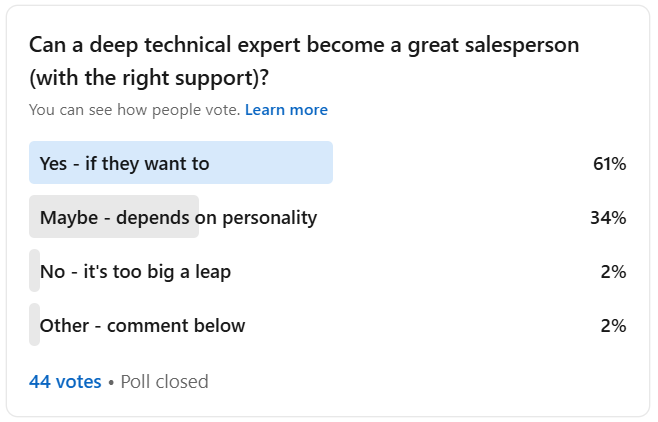
The reality is, however, that personality can be a blocker for some technical consultants when it comes to seeing themselves as effective salespeople. Many deeply technical people aren’t especially drawn to human interaction.
I say that without judgement. It’s an observation, but it makes sense. These are people who’ve spent their careers building deep expertise in a specific domain. They often identify much more strongly with the work itself than with the people around it. Their interests tend to be system- or topic-centred, rather than relational. They’re more drawn to things than people, broadly speaking. But, as we all know, people buy from people.
When they’re suddenly asked to become more ‘consulting-capable’, it can feel like an identity mismatch. And when that shift is stretched further to include sales conversations, it often results in wholesale rejection. The transplant doesn’t take.
My advice: Don’t leap straight to sales
Trying to take someone from deep technical expert to salesperson in one step rarely works. Unless someone already has a natural interest in commercial conversations, that kind of leap tends to get people defensive and reluctant rather than enthusiastic.
The language doesn’t resonate. The behaviours feel performative. The whole thing lands as inauthentic. Resistance is often the result.
Behind that resistance can be deeper stuff. Insecurity about how others might perceive them. Concern they’ll be exposed if the conversation moves outside their domain of expertise.
Fear of rejection.
Even a shift into a ‘trusted advisor’ space, which may feel like the middle ground, can be a stretch. It asks people to open up, to move from content into conversation, to initiate meetings without an immediate deliverable, or to engage clients beyond the boundaries of the work itself.
For some, those are deeply uncomfortable behaviours.
If you’d love your team to go on this journey, first ask yourself, “What is it reasonable to expect in terms of a shift on the axis from ‘deep technical delivery expert’ to ‘broad client relationship expert’ to ‘salesperson’?”
Start with motivation
Before you begin any kind of skills development or capability programme, you need to get underneath the behavioural ask and solve for desire.
Why would someone want to change? What might motivate them to try?
If you skip this step and go straight into capability-building, there’s a significant risk that people show up to training disengaged. I’ve seen it many times. They sit in the room, but because they haven’t chosen to be there they are cynical, suspicious, and searching for reasons why it won’t work. It really is an uphill struggle.
Simply, you won’t get meaningful change until the people in the room are choosing it for themselves, and that requires you to get deep into their motivations.
One of the most effective tools we’ve found to unlock this is the use of mindset statements.
This means creating the space for people to talk honestly about:
What they believe their role is
What they want their role to be
And what kind of mindset it will take to thrive in that role
With those statements documented we ask the participants to make a commitment. Are they bought into trying to operate from that mindset? And to shifting their behaviours where needed?
The tone of this session matters. It has to be open, transparent and safe - a place where people can share what feels uncomfortable or uncertain. Where debate can happen over what is or isn’t a reasonable expectation for that role. Where people can say “I don’t want to do that” without fear.
The outcome isn’t a slide deck or a framework. It’s a shared commitment: This is the job I’m signed up to, and I know what that will take.
The easiest way to get started with mindset statements is to brainstorm with the team and aim to get to 10 - 12 statements that cover a given role. These will typically be “I statements” (phrases that start with “I”). This is important as each person is owning these things for themselves. It drives commitment.
We find a set of sentence stems is a useful way to get into this brainstorm. Get people to write down as many phrases as they can think of, starting with these words.
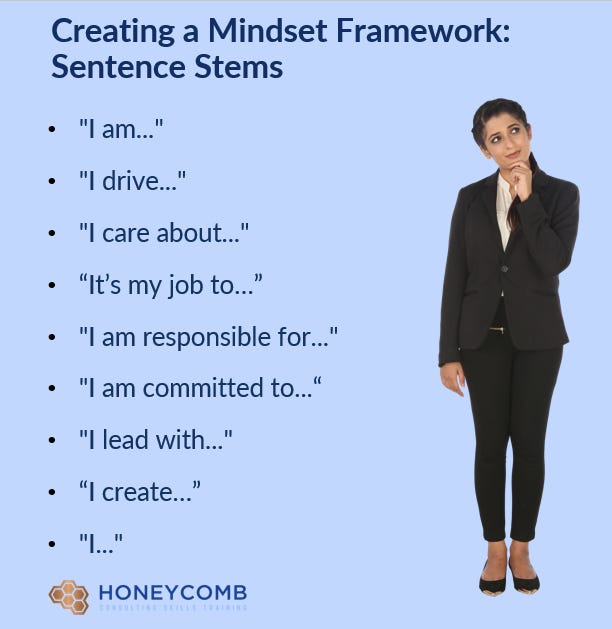
It can help to organise those against the sections of your competency framework, giving you 4 or 5 groups of phrases. Synthesise them down to an initial set and then discuss each one in turn.
The trick is to finetune the expectations. Say you’re talking to some Senior Managers and aiming to pin down exactly what they are - and aren’t - responsible for. In the domain of Sales the group may have written down things like:
It’s my job to deliver great work so clients come back for more
I’m responsible for staying in touch with my clients after a project ends
I drive new leads for the firm by regularly publishing new insights
I don’t need to create new opportunities yet
You can then debate which of those are true and which aren’t. Refine them. Iterate to a version everyone round the room is prepared to buy in to.
Ultimately you’ll end up with something like this:
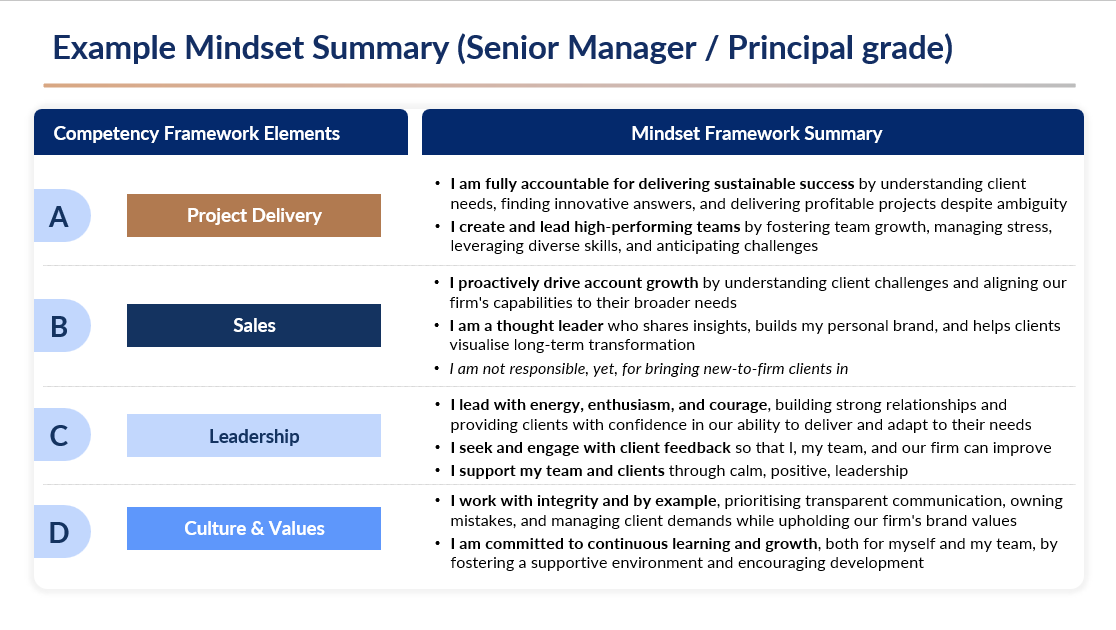
That process is super powerful. Your technical experts will start to see themselves differently, and be more accepting of help. Those people who might have shown up to training cynical, suspicious, and searching for reasons why it won’t work? Now they want to be there as they are bought into the ‘What’ and keen to learn the ‘How’.
If you want to get your technical experts on that journey from world-class at delivery to trusted advisors and revenue generators - even identifying as salespeople - you must get the mindset right first. Mindset statements are a simple and powerful tool to drive that.
Thank you for reading The Skilled Consultant. If you haven’t yet subscribed, please do so to receive all our articles direct to your inbox.
There are several other ways you can interact with Honeycomb Consulting Skills Training….
Connect with Deri Hughes (Founder & MD) on LinkedIn
Connect with Colin Mann (MD) on LinkedIn
Book a 30 minute intro call with Deri Hughes
Stay informed about our free workshops and webinars - follow Honeycomb on LinkedIn or visit our website.
Oooh I found more consultants! We must connect of course!