


I’ve been running a coaching programme for a team of talented software engineers. On the final call, four people brought challenges:
One of them asked how to say no to a client without damaging the relationship.
Another wanted to know how to be honest when he could see the client was approaching a problem the wrong way.
A third had a situation where something had gone wrong, it genuinely was not his fault, and the client was looking to him for an answer.
A fourth could see a client heading confidently down the wrong path, but did not yet feel he had earned the right to say so.
Four challenges, but one fear underneath all of them: that the honest move, the one their judgment is telling them to make, will cost them the client’s trust.
This is a common worry for consultants. And it is almost exactly backwards.
Why the difficult moments matter most
It helps to be precise about what trust actually is. The trust equation, from The Trusted Advisor, is our go-to framework: your trustworthiness is a function of your credibility, your reliability, and your intimacy with the client, all divided by your self-orientation. The more you are seen to be in it for yourself, the lower the whole thing falls.
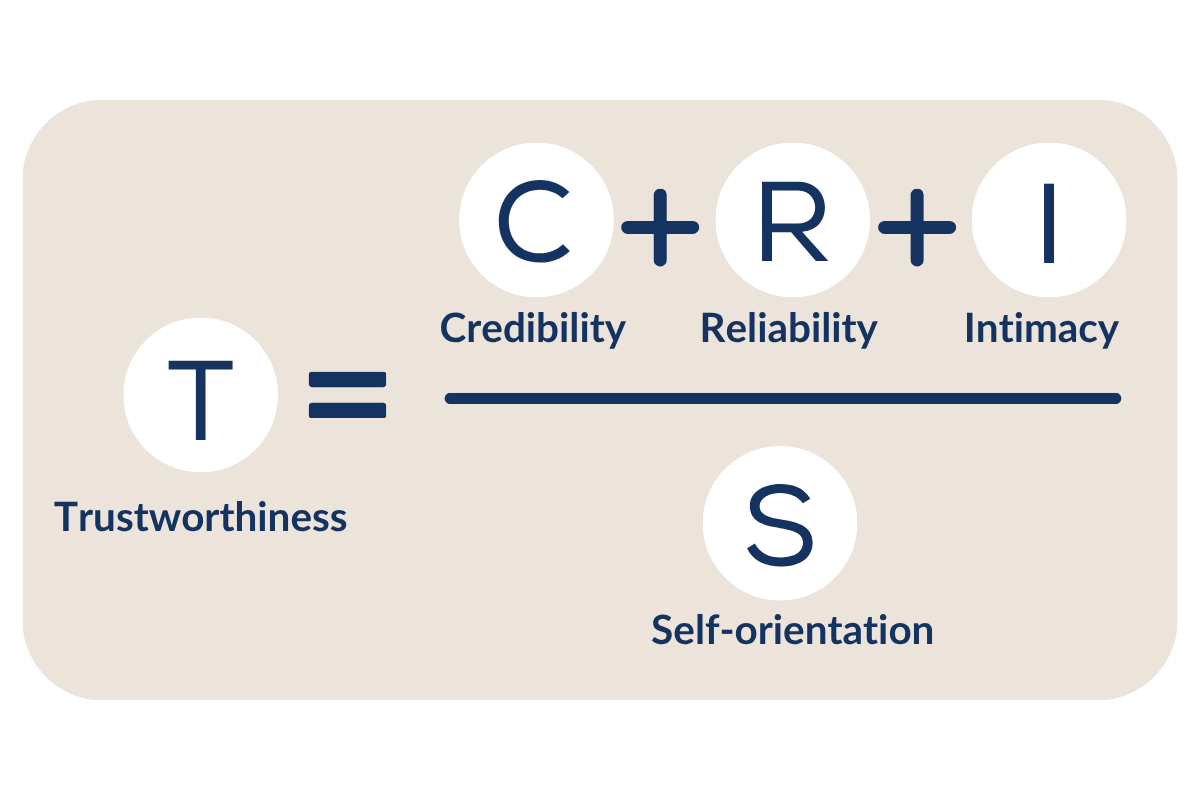
Now look again at those four dreaded conversations. Saying no, pushing back, admitting a mistake, flagging an uncomfortable truth: these are precisely the moments where intimacy can rise and self-orientation can fall. When you tell a client something they may not want to hear, and you do it for their benefit rather than your own comfort, you are demonstrating low self-orientation in the most visible way available to you. Handled well, the conversation you were afraid of is the one that moves the relationship forward.
Handled badly, of course, it does the opposite. So the question is not whether to have these conversations. It is how.
Here’s some ways you can approach it…
1. Speak from your own understanding
The single most useful tool is the ‘I statement’. Talk about what is true for you: your reading of the situation, your understanding, your concern. Rather than telling the client they are wrong, you say what you see.
“It seems to me that we are heading down the wrong path here, and the reason I think that is...”
“As I understand it, we agreed to...”
“I am a bit worried that we are missing something important.”
It sounds almost too simple, but it changes the temperature of the conversation completely. The moment you are offering your own view rather than passing judgment on theirs, it becomes much harder for anyone to take offence. You are also showing a little vulnerability, and vulnerability is one of the fastest routes to the intimacy the trust equation rewards.
A close cousin of this tool is ‘separating data, judgments and feelings’. When something has gone wrong and the temptation is to point a finger, anchor the conversation on the data: what actually happened. Someone sent an email, someone clicked a button, a release went out early. The data is neutral.
“This person did a poor job” is a judgment, and judgments are where conversations turn into arguments. Stay on what happened, and you aren’t attacking anyone. You are just describing the situation you are all standing in.
2. Signpost the hard part
There is a phrase I picked up years ago from a Bain partner I worked with - an Australian who had a knack for saying difficult things without causing offence. Before any message he thought might sting, he would simply say,
“Allow me to be provocative.”
Then he would say the hard thing.
That tiny preface does a lot of work. It warns people that a challenge is coming, so it does not blindside them. And, like an I statement, it adds a note of vulnerability: I know I am taking a risk here. My own preferred version is,
“I am going to take a risk and say what I think bluntly.”
The risk you are naming is a social one, and naming it openly signals that you care more about being useful than about being comfortable. That, again, is low self-orientation in action.
The aim throughout is to keep everyone feeling that you are on the same side, pulling in the same direction, rather than that you are avoiding responsibility or assigning blame.
3. How to say no, using ARTA
Consultants tend to find saying “no” very hard, partly because most of us don’t like disappointing people, and many of us are uncomfortable asking for money in return for our work.
It helps to reframe the request before you even respond to it.
A project with no change requests usually means one of two things: either you scoped it perfectly at the outset, anticipating every unknown, or, far more likely, you are following a plan that is no longer the best one and missing value sitting right next to the original brief. Change is not a threat to be managed down. It is often an opportunity worth exploring.
The foundation that makes the conversation easy is a clear agreement at the outset: scope and outputs agreed at the start, an explicit note of what is out of scope, and an outline of how changes get agreed. With that in place, I use a simple four-step process, ARTA:
Acknowledge the request and its value. “That is a great thought, and I can see why it matters.”
Remind the client of the original scope. “It sits outside what we agreed, so let’s look at the options.”
Trade-off. This is where the time, cost and quality triangle earns its keep. Any project is a balance of those three, and the old rule holds: you can have any two. So the options are always a version of the same three: reprioritise something else, add resource and cost, or accept a longer timeline. “We can absolutely do this, but there will be a knock-on effect.”
Agree, explicitly, what you will do and what you will not. “Here is what we’ll do.”
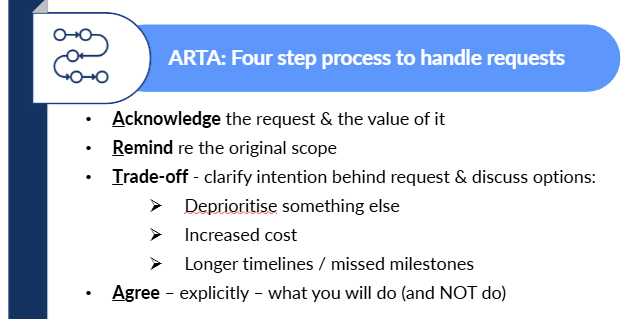
Notice that at no point do you actually say “no”. You acknowledge the value, you are honest about the constraints, and you hand the client a genuine choice. Often they decide the new request matters enough to fund it properly, and a piece of scope creep becomes a project expansion: a good outcome for everyone, provided you charge for it appropriately.
4. When you do not know the answer
The last variant is the one nobody escapes, least of all in fast-moving technical work: the client asks something and you do not know the answer.
The worst thing you can do is blag it. It feels like the right option in the moment, but it is the fastest way to destroy your credibility, and once a client suspects you will dress up a guess as an answer, they stop believing the answers you are sure of too.
There are really two situations.
If it is reasonable that you would not know, say so plainly: “this is outside my area, let me make sure I understand the question, and I will come back to you.” Flip it into a few good questions.
If it is something you feel you should know, take it on the chin. “I do not know exactly right now, let me take that away.” Or develop a hypothesis together, or, if the moment allows, research it there and then.
In every version, you are choosing honesty over the appearance of expertise. And honesty here is akin to reliability, and that helps build trust.
Actionable takeaway: Next time you feel the pull to soften a no, smooth over a problem, or talk your way past a question you cannot answer, treat that discomfort as a signal rather than a warning. It usually marks the exact moment where the relationship has the most to gain.
Lead with an I statement, stay on the data, name the trade-off, and tell the truth about what you do not know.
If you are working on lifting your technical people into genuine advisory roles, this is one of the harder shifts to make stick. Drop me a note or book a call using the link below, and I would be glad to talk through what we have seen work.
The Skilled Consultant is written by Deri Hughes and Colin Mann, Managing Directors of Honeycomb Consulting Skills Training. We help consulting leaders develop exceptional teams with world-class training to support every career transition.
If this article raised a question about your own team, do drop a comment below or book a 30-minute call with Deri or with Colin to discuss how we could help you.
Subscribe now to receive future articles and webinar recordings, or share this one with someone who may find it valuable.