


A consulting firm’s account plans can often tell you how much account growth is really happening. Not from what the plans say, but from how elaborate they are. The most comprehensive templates, the ones with a field for every conceivable detail, tend to be the least effective. They absorb all the energy. People spend much of their time filling in the document and almost none of it doing the things the document implies.
I say this having watched it happen many times, and having been guilty of it myself. It is a reminder of the phrase usually attributed to Eisenhower:
Plans are useless, but planning is indispensable.
The point of account planning is not the artifact. It is the act of thinking, deliberately, about how you are going to grow a client relationship.
So before you reach for a template, two questions are worth answering:
What does growing an account actually take?
And which way is this account going to grow?
1. What does it take?
We can look at this through the lens of the Honeycomb hexagon for exceptional performance consistency, which sets out six critical factors.
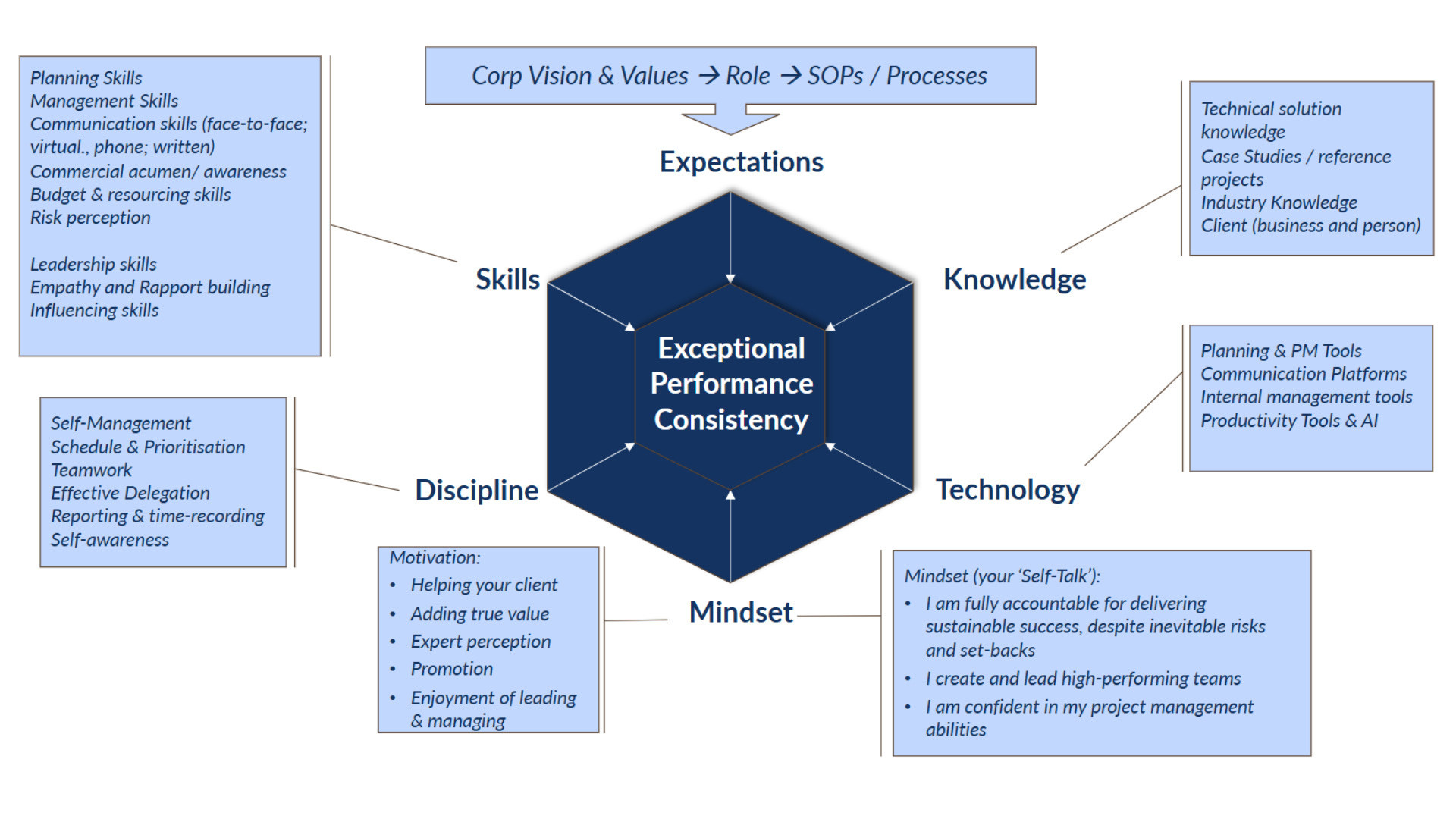
Expectations: Account growth rarely happens unless leaders make it clear that consultants are there to look for opportunity, not just execute the work in front of them.
Skills: The ones that count most are relational rather than technical i.e. building relationships, running opportunity conversations, asking great questions, and listening actively.
Knowledge: Less your own firm’s service catalogue and more a real understanding of the client and their industry.
Discipline: To protect the time and headspace to plan, rather than be pulled into project detail every time. This one is most commonly underestimated by leaders.
Technology: AI is becoming a genuine thought partner for account planning, helping you hypothesise about where an account might go. And a good CRM keeps you on top of the individuals and relationships you are nurturing across the account.
Mindset: If you do not believe that making time for this is core to your role, you will not do it. Often the unlock is being willing to delegate more boldly, so ‘not having the time’ is no longer an excuse.
Take a moment to consider how you, or your consultants, fair against each of these measures. Where are you strong and where is there work to do?
2. The three ways an account grows
Then the question becomes how the account actually grows, and it almost always falls into one of three routes.
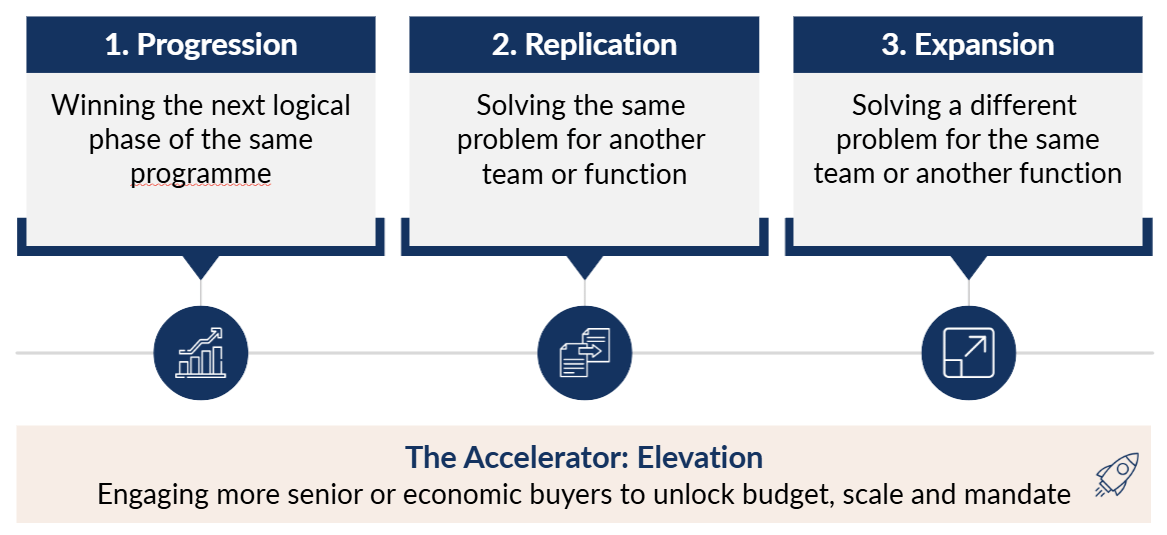
Progression is about doing the next logical phase. You delivered the strategy and the business case, so now you do the implementation planning. It looks like the obvious route, and it is the one most firms default to. It is also the riskiest. Projects lose funding, sponsors move, priorities shift. And even when they do not, there is a tendency to assume progression will simply happen, so we relax back from it.
Replication is solving the same problem for another team or function within the same client. In large organisations this works well, because you build a reputation in one corner and earn a referral across to another.
Expansion is taking a different problem to a client, sometimes one your firm has not tackled before. It is the most challenging of the three, because you are less credentialed in that space. But it keeps you innovative, broadens your footprint, and positions you as a genuine business advisor rather than a supplier stuck in one box.
When considering growth of an account, ask yourself which of progression, replication, or expansion you are intentionally pursuing, rather than assuming.
The accelerator to all three is Elevation: building more senior relationships inside the client. That’s the thing that most often unlocks growth and it is where consultants tend to get stuck - I turn to this in part two.
The Skilled Consultant is written by Deri Hughes and Colin Mann, Managing Directors of Honeycomb Consulting Skills Training. We help consulting leaders develop exceptional teams with world-class training to support every career transition.
If this article raised a question about your own team, do drop a comment below or book a 30-minute call with Deri or with Colin to discuss how we could help you.
Subscribe now to receive future articles and webinar recordings, or share this one with someone who may find it valuable.