

If you’re staring down a revenue target this year - whether it’s your first £250k or an established £5–10m - it can feel intimidating. An effective way to approach it is to break that number down into the behaviours that lead to success.
Let’s say you’ve got a revenue target of £1 million and your typical consulting project sells for £100,000. Simple maths suggests you need to sell 10 projects. But that’s only part of the story. You also need to factor in:
Conversion rates at each stage of your sales process
Timing - when work needs to be sold and delivered i.e. if you win 10 projects in September, you likely won’t deliver them all by year end.
This short guide gives you a practical model to plan backwards from your number, step by step.
Reverse engineer your sales behaviours
Most consulting projects start with a proposal. So the first step is understanding:
How many proposals you need to send
At what average value
And with what expected conversion rate
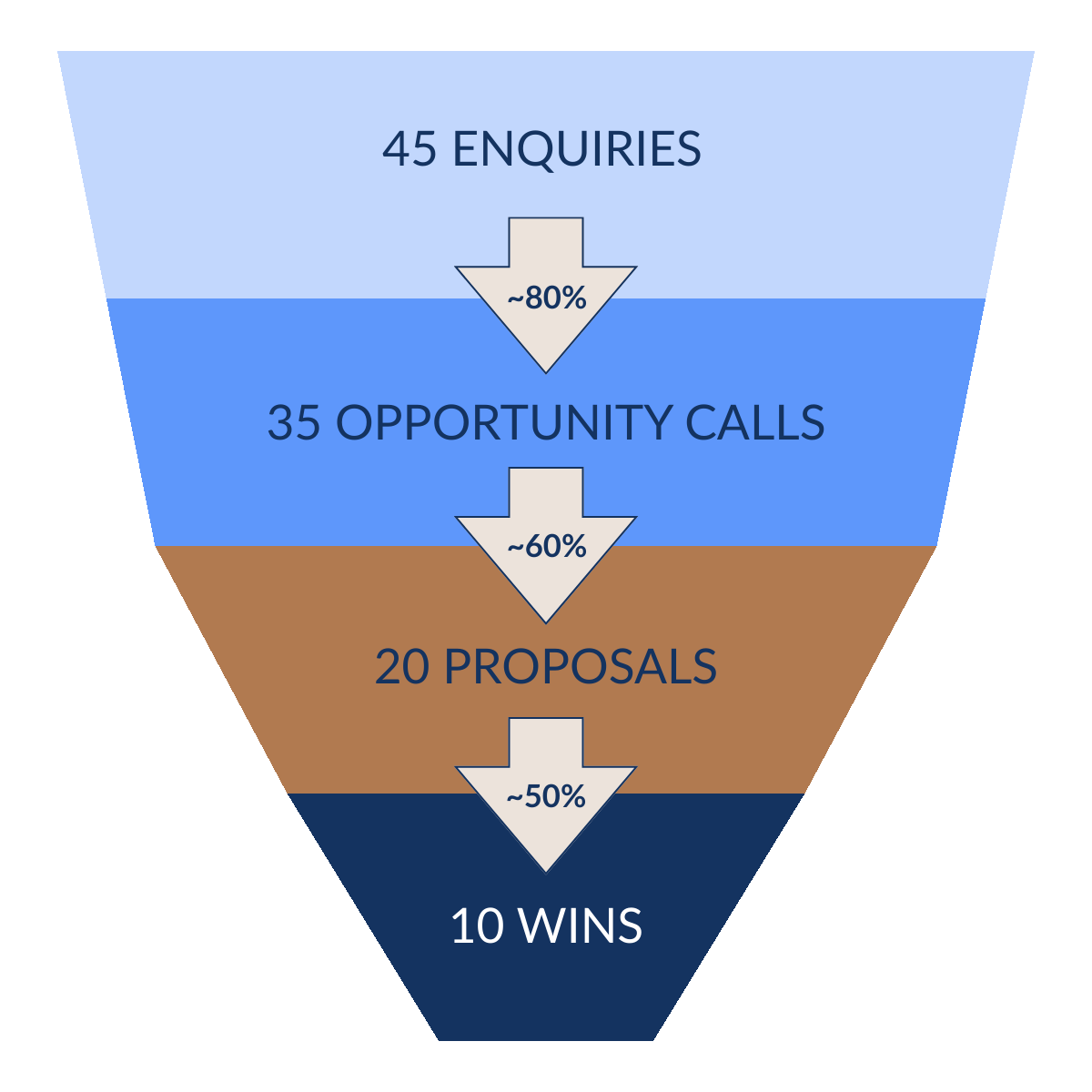
If your proposal-to-project conversion rate is around 50%*, then to win 10 projects, you’ll need to send 20 proposals over the year.
*50% is a sweet-spot conversion rate. If you’re achieving 75–80%, you may be pricing too low. If you are only getting 20–30%, your proposition may be unclear, or perhaps you’re sending cold/underprepared proposals.
But you can’t send a proposal until you’ve had a conversation about an opportunity. We call these opportunity calls - and we define them as any conversation related to a new piece of work not currently in your pipeline. These can be with a new prospect or a new person inside an existing client.
Not every opportunity call leads to a proposal. We typically find that about 60% of opportunity calls result in a proposal being sent.
Upstream from that, you need to look at enquiries or early-stage potential opportunities. Not all enquiries lead to an opportunity call. We typically see about 80% convert into a real conversation.
So, in this example, for every 10 projects you want to win:
You may need to send 20 proposals
Which means having ~35 opportunity calls
Which requires ~45 inbound enquiries
Timing is everything
Of course, you then need to consider when each of those steps must happen and the phasing through the year. We find a good rule of thumb to be:
A proposal should go in at least two months before you expect to recognise revenue
An opportunity call should happen a month before that i.e. at least three months before revenue is booked
Your experience may be different, but it’s valuable to know the typical lag for your sector and cliental. Once you understand this, you can phase not only your revenue targets for the year, but your enquiries, opportunity calls, and proposals targets too.
Then track them.
If your enquiries are lagging now, you are building up a problem for yourself in Q2, so get focused on some ‘top-of-funnel’ activity that will move you back on track.
If you’re not planning at this level of detail, you’re trying to hit a sales target with a strategy of hope. And hope is not a good strategy.
“Failing to plan is planning to fail”
If you haven’t got a 2026 plan yet, take an hour and write down your best guess at:
Your project volume and average value
Your proposals target
Your opportunity calls target
Your enquiries target
Your top-of-funnel activity plan
How this all should be phased by month
If you want to pressure test your numbers with us, just drop a note in the comments.
The Skilled Consultant is written by Deri Hughes and Colin Mann, Managing Directors of Honeycomb Consulting Skills Training. We help consulting leaders develop exceptional teams with world-class training to support every career transition.
If this article raised a question about your own team, do drop a comment below or book a 30-minute call with Deri or with Colin to discuss how we could help you.
Subscribe now to receive future articles and webinar recordings, or share this one with someone who may find it valuable.
Great article. Because our pipeline has been incredibly lumpy and largely affected by economic and political events it’s helpful to distill our funnel into aggregate numbers and have these drive our behaviors. Thx for this!