


There’s a tough point in the consulting career ladder that catches a lot of people off guard. It’s the step into senior manager and director positions. Here two things collide and conflict. You move from leading one project well, to having two or three on your plate and you’re being asked to play a bigger role in business development.
It sounds like a natural evolution. But in reality, it’s often where good consultants start to feel overstretched, unclear, and on the back foot. Delivery still needs to happen. The quality still has to hold. And yet, time spent on project work is time not spent growing the business or building client relationships.
I’ve been there myself. You go from being the person who does the thing, to the person who has to make sure other people are doing the thing — and doing it well across multiple teams, clients, and workstreams. If you’re not careful, you end up back in the weeds, just with less time and more pressure.
So how do you lead across multiple projects, protect quality, and still create space to step up into your new role?
“I can’t step back - I’m accountable”
This is one of the most common phrases I hear from people.
I get it. Most of us have spent years building our reputations by delivering. Letting go of that core activity feels risky. But your role is shifting. It’s no longer about what you can personally deliver but what your team can deliver, with your support.
That means you have to manage differently. Oversight has to replace ownership. Support replaces control. You’re still accountable, but the way you carry that responsibility has to evolve.
There are two critical enablers that make this work:
Delegating well
Establishing layered oversight
1. Delegate well: look for low-risk, not low-effort
When people start delegating, they often focus on low-effort tasks: admin, formatting, quick bits of work. But the real unlock comes from delegating low-risk, high-effort work; things that don’t need your expert judgement, but take up a lot of your time.
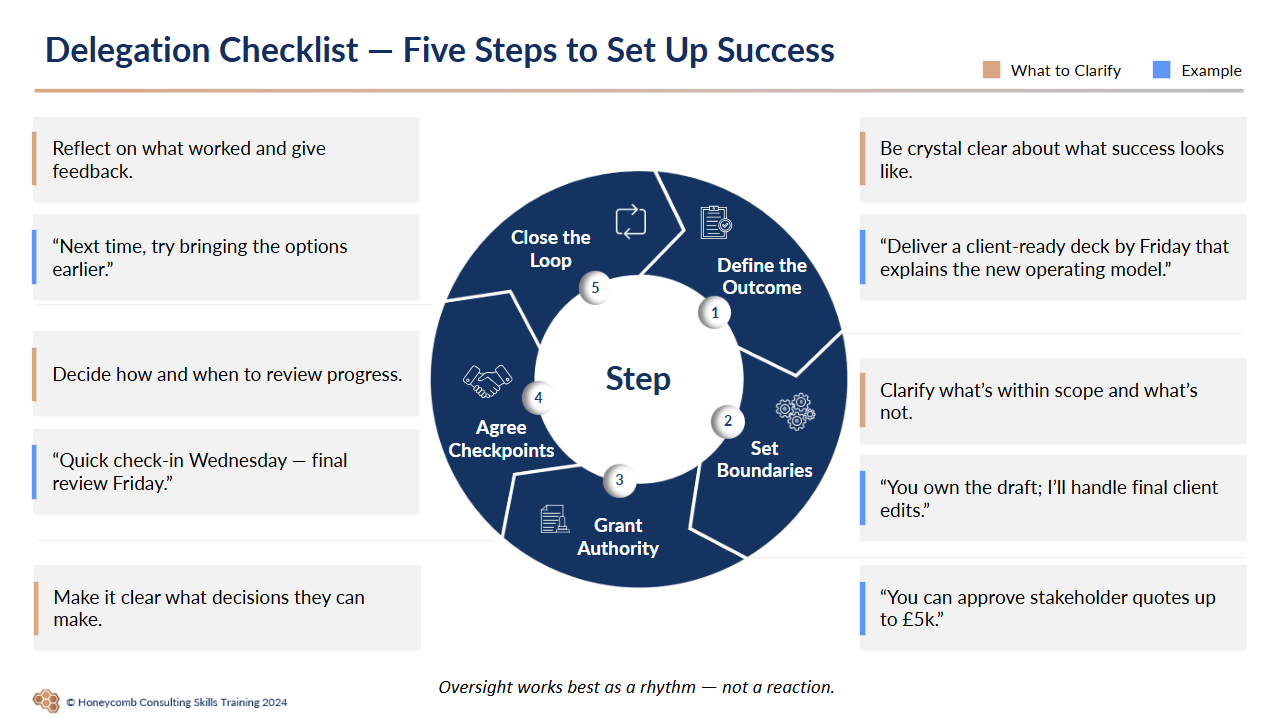
Then, how you delegate matters as much as what. You have to give your team the authority to own their work. That includes decisions. If you hold on to every decision, you have to stay across every detail. You’ll inevitably become a bottleneck (and exhausted!).
If the idea of relinquishing control is giving you the jitters, it may help to follow a delegation checklist such as this:
There’s a mindset shift here, too. Someone doing the task differently from how you would isn’t necessarily a problem. In fact, they might do it better (this happens more often than we like to admit!). And, even if it’s only 80% of what you’d have done, the time and development/growth gains (for you and your team) are usually worth it.
2. Establish layered oversight: a system for confidence
Delegation only works if there’s a system that keeps you confident in what’s going on, without dragging you into everything.
In my first career, I worked in aircraft engineering. Junior technicians were often trusted with critical inspection tasks. There was no blind trust or abdication of responsibility - people’s lives were on the line. But it worked, thanks to the layered assurance system.
First, we had strong systems: checklists, training, and clear documentation. Then, spot checks: experienced engineers would drop in, check a few tasks, and catch issues early. And finally (most importantly), the culture supported it. You were expected to own your work, ask for help, and flag problems early.
That mindset maps surprisingly well into consulting. You don’t need to inspect every deliverable, but you do need to:
Have a plan that’s visible and actively used, a basic risk register, or a simple reporting system.
Build in review moments that don’t rely on memory or goodwill e.g. spot checks, reviewing a sample of reports weekly.
Create a team culture where quality, honesty, and trust sit side by side and people feel confident to surface concerns and questions.
All three layers matter. Together, they create the conditions for you to lead across multiple projects without being constantly pulled back into detail.
Build a rhythm that works for you and your team
Oversight doesn’t have to mean lots of heavy meetings. I’ve seen people run this well using a simple weekly rhythm:
A light-touch check-in on Monday: “What’s on this week? What’s got you worried?”
A midweek review of something in progress: “Let’s glance at the draft now, not at the final hour.”
Friday reflection: “What worked? What do we need to tune for next week?”
This rhythm gives you good visibility without micromanaging. It also gives your team clarity about when and how you’ll be involved, which means fewer ad hoc interruptions, and more focused support.
Other tools I’ve seen work:
A short escalation matrix: what needs to come to you, and when
A shared quality checklist: what “good” looks like for key deliverables or meetings
A rolling delivery tracker: just enough to spot drift before it becomes a problem
These don’t need to be heavyweight processes. Think of them as scaffolding — enough structure for people to do their best work without you hovering over them.
Can you handle the white space in your diary?
When we get deeper into this stuff in training programmes, it often becomes clear that the real barrier to progress isn’t practical, but emotional.
Creating space in your diary can feel uncomfortable. If you’re not fixing things, chasing deliverables, or solving client problems, what are you doing? If your value has always come from being dependable in delivery, stepping back can feel like a loss of identity.
And then it’s harder to avoid the lurking internal voice that says, “You should be using that space for business development.”
The majority of consultants experience resistance stepping into sales and BD. It feels unfamiliar, it’s less structured and more relational, and you don’t get the same direct feedback. All in all, it can feel ambiguous and exposing.
“I don’t really want to create time because it means I’m then a bit exposed to having to demonstrate success in BD.”
Tackling that fear - recognising that (quietly, perhaps subconsciously) you are holding yourself back by keeping busy with what you know - can often be the biggest unlock.
We have lots of resources which dive further into sales processes and psychology. If you’re interested in learning more, our webinar Consulting Sales Demystified could be a good place to start - CLICK HERE to watch on demand.
The Skilled Consultant is written by Deri Hughes and Colin Mann, Managing Directors of Honeycomb Consulting Skills Training. We help consulting leaders develop exceptional teams with world-class training to support every career transition.
If this article raised a question about your own team, do drop a comment below or book a 30-minute call with Deri or with Colin to discuss how we could help you.
Subscribe now to receive future articles and webinar recordings, or share this one with someone who may find it valuable.