


Clients come to us with delegation problems a lot. Sometimes it’s a manager who keeps getting back something different from what they wanted/expected. Sometimes it’s a firm leader looking at their management group and seeing people who hold on to too much, for too long.
Delegation is the most frequent leadership act in consulting. It happens every day, on every engagement. Yet very few of us were ever trained to do it. Most of us copied the people who led us, mistakes included: holding on too long, handing over the wrong thing, or taking work back because it isn’t going the way we pictured.
Firm leaders also tell us that their people “don’t take enough ownership”. Last month I wrote about what ownership means for the consultant, and how it can be trained. This article is about the other side of that coin.
Leaders can’t assume their people will own things naturally. Ownership has to be handed over, and delegation is how that happens.
Delegation should have a ‘small d’
Situational leadership sets out four styles - directing, coaching, supporting, and delegating - to be chosen according to someone’s competence and confidence in a particular task. We use it regularly in our leadership training, and I love how quickly it gets people thinking about the way they lead.
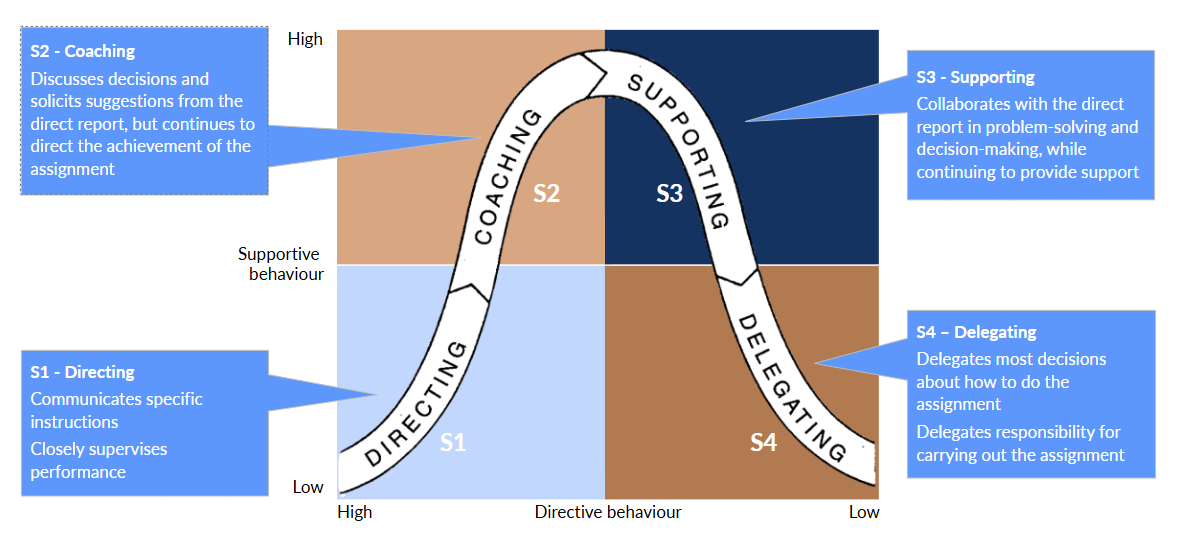
My one challenge with the model is the word “delegating”. It’s here with a capital D, for one specific style - delegating ownership. But delegation with a small d happens in every box.
Two modes of delegation
We can think about delegating in two different ‘modes’:
Delegating a task → produces a product.
“Build this model.” I still own the problem; I want you to produce that piece of it.
Delegating ownership → produces an outcome.
“Create the recommendation that’s going to delight this client.” I’m passing over ownership of the problem, including the decision rights and the authority to define what you’re solving. I may provide a safety net.
Before you delegate, ask yourself which one you’re doing. Name it explicitly, and check it’s been understood. A lot of delegation failure starts with a lack of clarity on this point.
1. Delegating a task well
Task mode is often right: a high-pressure project, or someone new with low confidence or competence in that area. Be upfront that you’re handing over small, discrete pieces of work with regular check-ins. Specify the product and the standard you want back, the method where it matters, any decisions they can make, and when they must come back to you.
These days, a delegated task will often be passed on in part to AI. Agree at the outset how AI can be used and how its outputs will be tested. Then review the product in detail and give feedback. You’re still accountable for its quality.
2. Delegating ownership well
When the problem and the person allow it, you’ll need to hand over ownership of the outcome. Make sure they acknowledge this too, particularly if it’s new to them.
You must hand over decision rights, calling out any exceptions where you want to be consulted. Accept that they may take a different path from yours, and that theirs might be better. They may not feel confident, so tell them: “I trust your judgement, and your view is as valid as mine.”
The step leaders struggle with most often is delegating the client relationship. Clients tend to default to the most senior person in the room, so your junior needs you to reset that expectation. If you stay in the middle as the filter, you haven’t let go.
That may mean a conversation with the client: “Sarah’s leading this one. She’ll make the decisions and stay close to you. I’m always on the end of the phone, but you’ll get your inputs directly from her.”
You’re moving from gatekeeper to sponsor: visible and important to the relationship, but out of the nuts and bolts. Those conversations can actually strengthen the client relationship. Being open with a client about developing your team often prompts an equally open conversation about how they’re doing the same, which builds exactly the intimacy the trust equation describes.
How do you keep oversight on quality?
Quality is everyone’s biggest worry. Will they do it well enough, and how will you be sure?
In task mode, checking is fairly mechanical: you review the model/the numbers/the slides in detail. Spot check for errors, provide some feedback, assure yourself it works.
In ownership mode, what you’re actually checking is judgement, and leaders can struggle to know how to approach that.
Here are a few ways in…
Look hard at the first 20%
How was the problem framed? What approach was designed? What storyline is being developed for the client?Stress-test the thinking
”Talk me through the methodology. What assumptions did you make? Where will the client push back?” Listen to the answers and the confidence behind them.Ask how they assured it, without redoing it yourself
If they sense you’ll check everything anyway, you become the safety net and ownership drains away. The same goes for AI: ask how it was used and how the outputs were validated.
The most useful question is a short one: how do you know? The answer shows how much judgement they’ve applied.
Why we hold on when we should let go
When we start exploring delegation challenges in firms, the same patterns tend to emerge.
It’s common for managers or leaders to say (and think) they are handing over ownership, but their behaviour tells a different story. They delegate a problem to someone, then direct them on how to solve it - they’ve just pulled ownership straight back.
People often raise seemingly legitimate objections. Fear about quality is a common one: “This one’s tricky. I’ll be bolder on the next project.” But in consulting, the next project will also be tricky. Getting off a blank page is a skill juniors only build if we give them the chance.
When we dig a bit deeper, there’s usually a shadow reason for this hesitancy: I want to be seen as the expert, the person all over the detail. Handing over ownership means letting go of a piece of your identity - something you’ve worked hard to forge. That’s likely to be uncomfortable and require some personal confrontation, so people find reasons to avoid it.

Alongside the tools and techniques we can train, helping people notice that shadow on their shoulder can be a critical unlock.
If this is a challenge in your firm, I’d be glad to talk through how we approach changing behaviours and what we’ve seen work. Just drop me a line.
Thank you for reading The Skilled Consultant. If you haven’t yet subscribed, please do so to receive all our articles direct to your inbox.
There are several other ways you can interact with Honeycomb Consulting Skills Training….
Connect with Deri Hughes (Founder & MD) on LinkedIn
Connect with Colin Mann (MD) on LinkedIn
Book a 30 minute intro call with Deri Hughes
Book a 30 minute intro call with Colin Mann
Stay informed about our free workshops and webinars - follow Honeycomb on LinkedIn or visit our website.