


Show me a consulting leader who hasn’t asked, “What happens to the apprenticeship model if we move to diamond structures with fewer juniors?”
It’s the industry’s challenge du jour. If AI agents are doing the research and analysis, and workflows become more streamlined, consulting firms may well conclude they don’t need a bottom-heavy resourcing model. Where then do our industry’s future Managers and Partners come from?
Let’s start by bringing in a dose of reality.
Very few firms have actually moved to a diamond model yet. Very few are systematically using AI to redesign workflows end-to-end. Most firms are still in the realm of individual consultants using individual tools for individual tasks. Someone chucks something into ChatGPT, or Claude, or Copilot to help them do a task a bit faster.
This is not yet a structural problem.
So, the question we should ask today isn’t, “How do we adapt to fewer juniors?”
It’s, “How do we design the role of juniors deliberately before the structure shifts under our feet?”
The role of juniors is evolving, not disappearing
The classic pyramid model has been around since consulting began. Partner at the top, senior manager beneath, then consultants and junior consultants at the base. The size varies, the leverage changes, but the logic has endured.
Now we’re starting to see experimentation with something closer to a diamond.
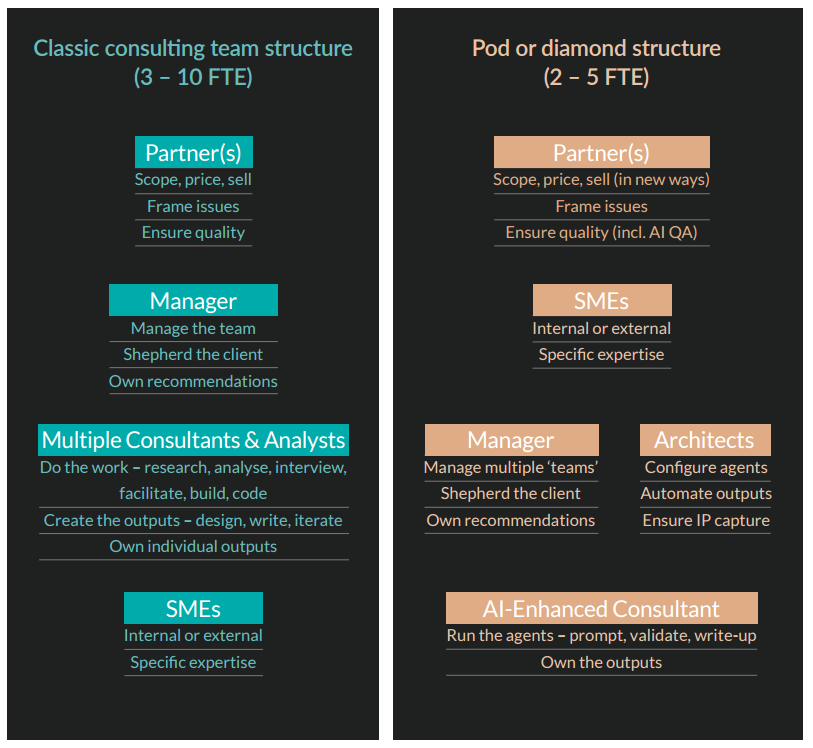
Under the Partner you have subject matter experts (SMEs). You have people building and operating AI agents. And the junior role shifts from:
Research. Analyse. Write up.
to:
Prompt. Validate. Write up.
That is a new skillset. Prompting and validation are techniques to be learned and they require judgement. But in many ways, the fundamentals haven’t changed at all.
Juniors still need to sort the wheat from the chaff. They still need to pull up to the key insight. They still need to persuade clients to share information. They still need to work extremely fast to solve extremely complicated problems.
The mistake is to look at this shift and only see productivity and cost efficiency.
Because you miss two critical roles that juniors will play in the ‘2026 and beyond’ consulting firm.
1. Replication: the AI skill nobody talks about
People talk a lot about validation when it comes to AI. Very few talk about replication – and replication is critical.
AI models hallucinate. They generate inconsistent outputs from consistent inputs. They can produce something that looks convincing but is fundamentally flawed.
So part of the QA process must involve replication. A second person rerunning the logic. Rechecking the prompts. Reproducing the analysis independently.
If you design your future team assuming one junior does ‘Prompt. Validate. Write up.’, you may miss the fact that you also need ‘Replicate. Finalise.’
By a different person.
If you don’t factor replication into your QA process and your resourcing model, two things happen:
You become under-resourced at the junior level.
You introduce client risk into your system.
Ironically, the firms that take AI most seriously may find they need more junior capacity, not less.
2. The two-way apprenticeship model
The second shift is cultural. The classic apprenticeship model is simple: juniors learn from seniors. They shadow. They receive feedback. They develop judgement through exposure.
But in the current environment, seniors also need to learn from juniors. That’s not a comfortable idea for everyone, but it’s increasingly necessary.
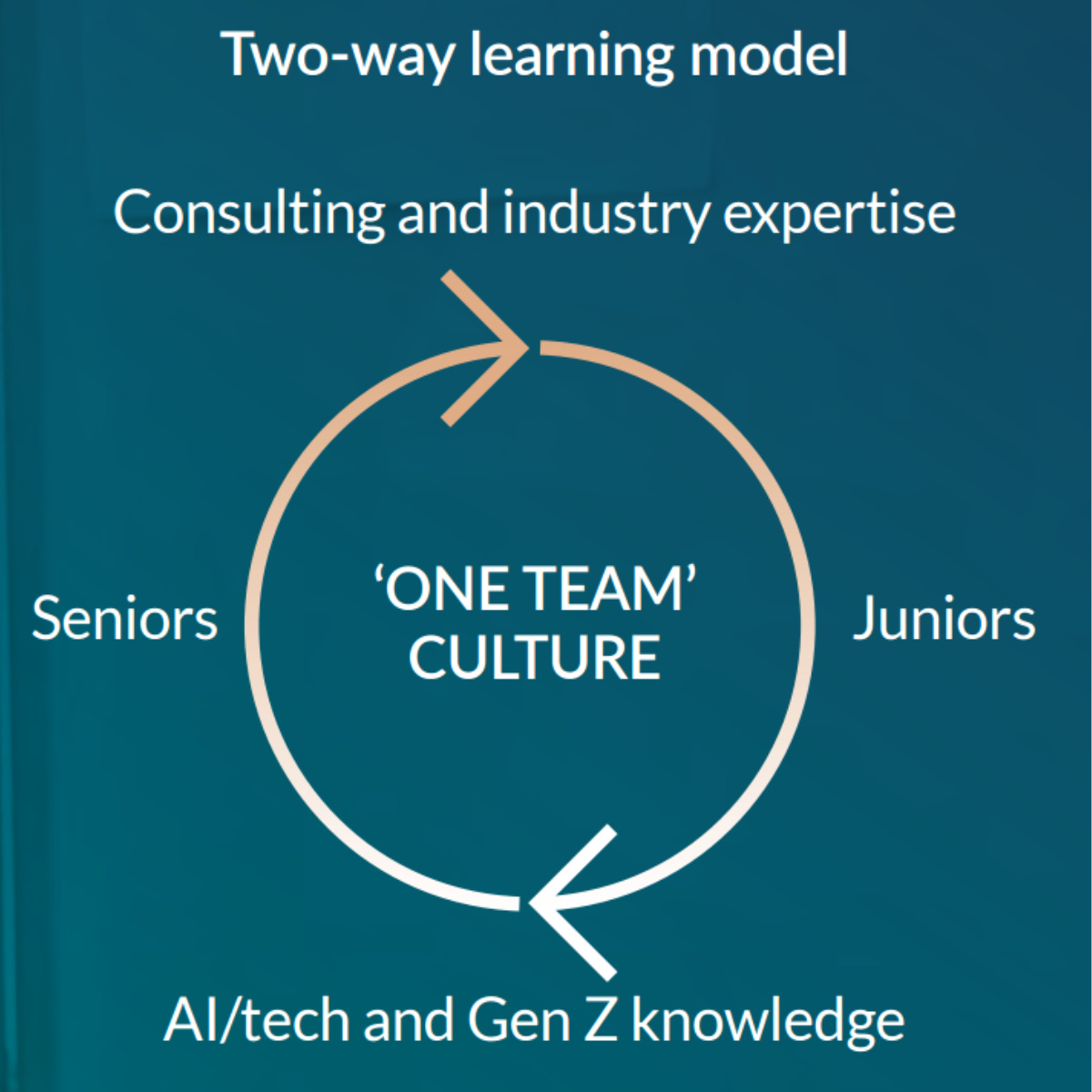
In The Consulting People Report 2026, we highlighted that AI, hybrid working, and generational shifts are likely to hit the senior team harder than the junior team. Seniors must unlearn and relearn long-entrenched behaviours. They must build capabilities they haven’t needed before.
Your juniors can be a secret superpower in that transition.
There are two dimensions to this.
Technology fluency
Many senior leaders - particularly those in their late 40s and above - are not digital natives. Many millennials are not AI-native either. Gen Z are further ahead, and Gen Alpha will be further still.
If you view your juniors as a source of expertise on tools, workflows and digital habits, there is real value there. This requires explicit design. Structured moments where seniors are learning from juniors about AI use cases, digital behaviours, emerging norms.
Generational understanding
Repeatedly in conversations with consulting leaders, we see the mismatch between Gen X and Millennial leaders and Gen Z or Gen Alpha juniors. Expectations around work-life balance, flexibility, hybrid working and what is “reasonable” at work have shifted.
It takes a curious, self-aware leader to lean into that gap rather than dismiss it. But if you see your junior team as a source of insight into how these generations think and operate, there is enormous value. Not just internally but also in how you advise clients who are grappling with the same generational shifts.
You may need more juniors than you think
If you look at juniors purely through the lens of productivity, you might assume the base of the pyramid shrinks. If you factor in replication and two-way apprenticeship, you may conclude something different:
You still need junior capacity for robust QA.
You need junior expertise to support senior capability shifts.
You need to invest in juniors deliberately for medium and long-term leadership development.
The model will shift - that seems inevitable. But the apprenticeship model is not disappearing. It is becoming more reciprocal, more deliberate, and more complex.
What do you see happening in your firm?
The Skilled Consultant is written by Deri Hughes and Colin Mann, Managing Directors of Honeycomb Consulting Skills Training. We help consulting leaders develop exceptional teams with world-class training to support every career transition.
If this article raised a question about your own team, do drop a comment below or book a 30-minute call with Deri or with Colin to discuss how we could help you.
Subscribe now to receive future articles and webinar recordings, or share this one with someone who may find it valuable.