


I’ve had several conversations in recent months with consulting firm leaders who have concluded they need a new operating model. The reasons vary: a feeling of chaos in the team, persistent conflict at the senior level, a lack of clarity about who owns which decisions. Or sometimes a more forward-looking concern: is our current structure fit for what consulting looks like over the next two to three years?
Their challenges are in different places, but they tend to arrive at the same point. And what I’ve found, more often than not, is their conclusion is misplaced. The operating model is not usually the problem.
What does ‘Operating Model’ actually mean?
When I ask a group of consulting leaders what they mean by operating model, I rarely get the same answer twice. For some, it means the org chart: who is responsible for which parts of the business, who reports to whom. For others, it means revenue flow: who is on the hook for generating which numbers, and how performance is measured and managed around that. For others still, it means decision ownership: who makes which calls, and at which level.
My preference is the decision ownership model. It tends to cut through a lot of the noise. But whichever version you use, the same principle applies: restructuring the model will not solve your problem if the root cause is something else entirely.
The foundation everything sits on
Working with consulting firms across different sizes and structures, I’ve developed a framework that draws on two established models: Richard Beckhard’s model of team effectiveness and Patrick Lencioni’s Five Dysfunctions of a Team. What the framework makes clear is that at the centre of any effective operating model is something no org chart can create for you: working relationships and trust.
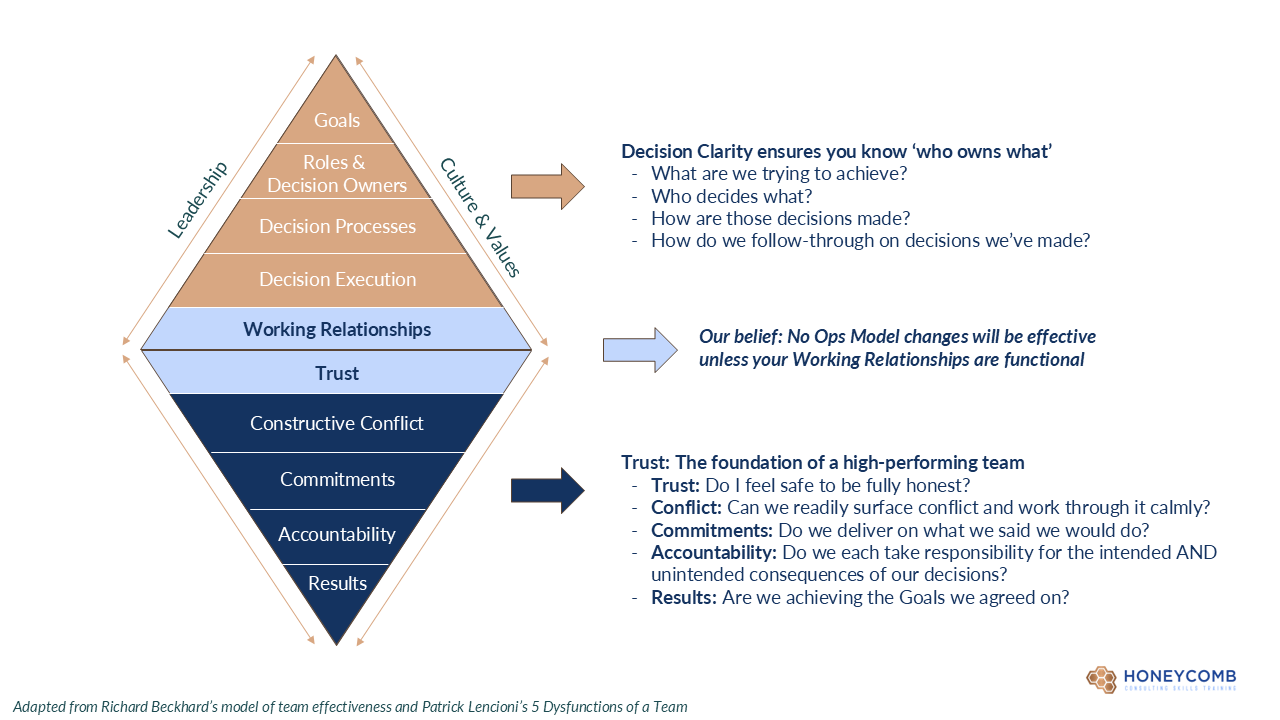
If your senior team is communicating clearly, making decisions collectively, and backing each other up, then a relatively light redesign can get you a long way. You might need to clarify a few roles, tighten up some decision rights, and you are done.
But if the word you would use to describe your senior team at the moment is ‘chaos’ or ‘conflict’ or ‘avoidance’, then the operating model is not your presenting problem. You have a leadership behaviour issue. And putting new boxes on a page will not fix it.
Diagnose first, design second
The most useful first step is a diagnostic question: is this a design problem or a behaviour problem?
If the team is working well together and the issue is that roles and responsibilities are unclear or misaligned, then a structural redesign may be exactly what you need.
If the team is not working well together, the sequence matters. You need to address the behaviours first, or the new structure will simply become a new arena for the same conflicts.
When you are ready to redesign, be specific about what you are asking of people. If you want your directors to take on P&L ownership, or your sector leads to drive sales, then be clear about what that means in practice: which decisions they will make, what support they will have, and what you will stop doing that currently blocks them* (more on that below!).
If your expectations are clear, people are bought in, and someone is still not delivering, then you have a different problem to diagnose. It might be capacity: they simply do not have the time. It might be a skill gap: they have not yet built the capability you are asking for. Or it might be an inner-game issue, a mindset that needs to shift before the behaviour can follow. Each of those calls for a different response.
*A common problem: founders who need to step back
Every firm owner and founder knows this truth: you need to be working more on the business, not in it. Meaning, step back from the day-to-day delivery, the sales process, the operational decisions. Spend your time on strategy, positioning, the medium and long-term direction of the firm. This shows up particularly sharply in founder-led businesses as they scale.
But what I find is that founders rarely ask themselves the question that makes it possible: if I want my senior team to step up and own more, what do I need to stop doing to create the space for them?
That is a hard question. It requires a clear-eyed look at your own behaviours, including the unconscious ones - the ones your colleagues can see more clearly than you can. Getting out of the way is not passive; it is an active and demanding behaviour change on the part of the person at the top.
Actionable takeaway: Before you draw any new boxes on a page, answer two questions candidly.
Does your senior team have the working relationships and mutual trust to make a redesigned operating model work?
Is there behaviour change required at the top of the firm, including your own, before you ask others to change?
If the answer to either is uncertain, start there.
If you are working through this kind of challenge at the moment, I would be glad to talk it through. Drop me a note or simply book a call using the link below.
The Skilled Consultant is written by Deri Hughes and Colin Mann, Managing Directors of Honeycomb Consulting Skills Training. We help consulting leaders develop exceptional teams with world-class training to support every career transition.
If this article raised a question about your own team, do drop a comment below or book a 30-minute call with Deri or with Colin to discuss how we could help you.
Subscribe now to receive future articles and webinar recordings, or share this one with someone who may find it valuable.