


When it starts to rain, you put your umbrella up. When it stops, you put it down. It is a perfectly sensible way to deal with the weather, and it mirrors how a lot of consulting firms deal with their sales pipeline.
The pipeline looks thin, so we do something. It fills up, so we stop. There is nothing wrong with that reaction in itself. But if it is your entire sales strategy, you are guaranteeing yourself a boom and bust cycle.
The firms that break out of that cycle think differently. Alongside the short-term reactions, they systematically build the long-term capabilities that let them respond to whatever market conditions they find themselves in.
Putting the umbrella up
Most of us know what the short-term actions look like. A burst of cold emails. A round of shaking the trees with your contacts. A spray of messages to old clients that start with “just checking in”.
These actions can work, but they feel salesy and a bit desperate, and if you are not careful with how you do them, that is exactly how they land. They are also characteristic of a firm stuck in the boom and bust cycle: selling hard when the pipeline is empty, too busy delivering to sell when it is full, and then back to the start.
So the question I would put to any firm leader looking nervously at their pipeline is this: alongside the short-term actions, what are you building that will make next year more predictable than this one?
Three ways to grow, three assets you cannot rush
At Honeycomb, we describe three modes of growth for consulting and advisory firms: delivery-led growth, where you do great work and you get more of it; relationship-led growth, where people trust you as an advisor and come to you to solve their problems; and authority-led growth, where people discover you as the expert in your field and come to you to find out whether you can help them.
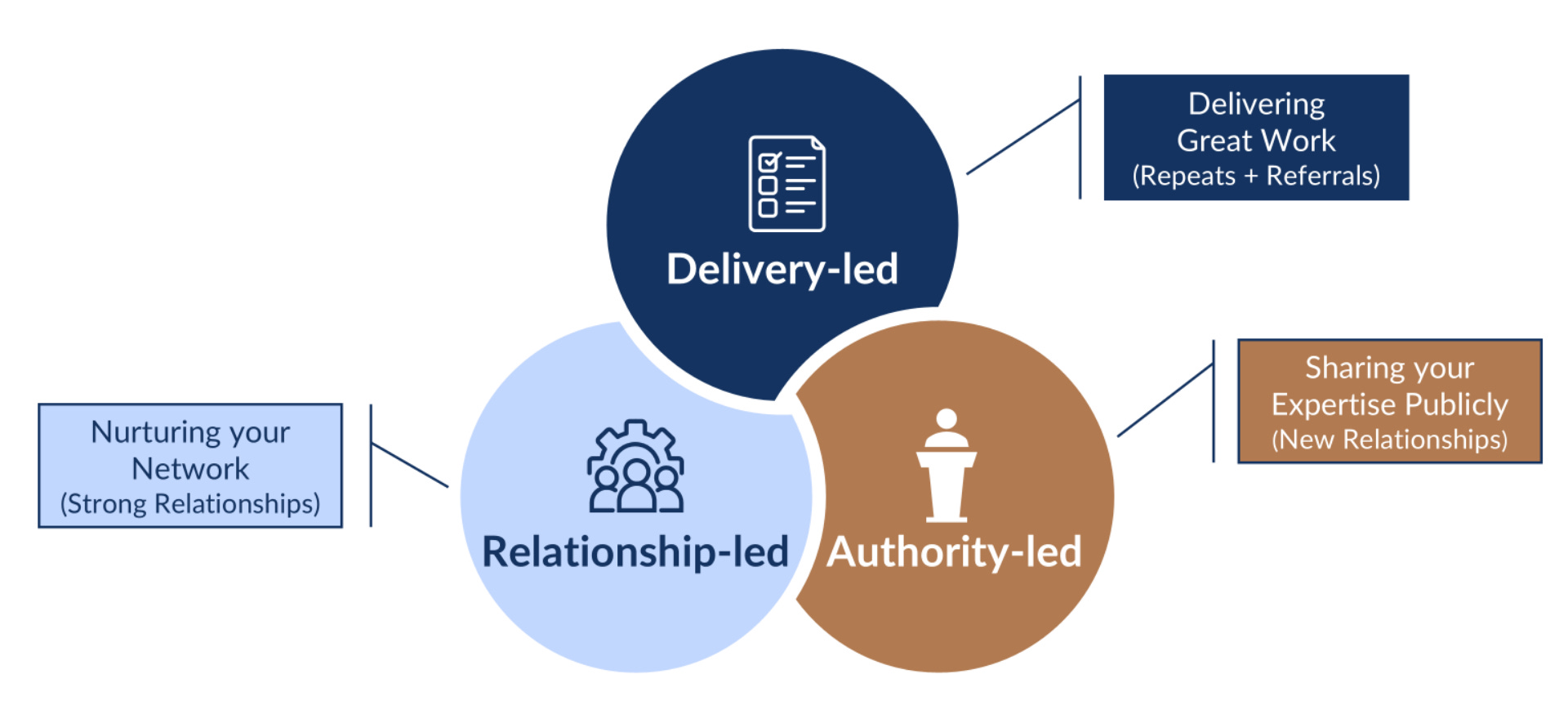
Each of those growth modes relies on a long-term asset, and none of the three can be built quickly.
Deep expertise and a systematic methodology.
To grow through delivery, you need real depth in what you do, and a repeatable way of creating value for clients. The test is whether your team can deliver that value predictably, time after time, rather than relying on a few individuals to pull it off.
Network.
To grow through relationships, you need to know the right people, and the network that counts is the combined network across your whole team. Nurturing it means paying attention to its quality, and not just to how many people are in it.
Reputation.
To grow through authority, you need to become a visible expert. When someone who has never met you comes across your work, they should immediately understand who you are, the type of people you help, and the type of problems you help them with. And you need to be seen widely enough that new people keep encountering you.
I think of reputation as the holy grail of consulting sales. Build that and you start to see inbound enquiries. A perfect-fit client, who is ready to buy, lands in your inbox and books a call in your calendar. They tell you they have been following you for a while, they like the way you think about a particular problem, and they are wondering whether you can help.
If you get that and you still cannot close the deal, you have got to ask yourself some hard questions.
Invest consistently, whatever the cycle
If you are serious about making sales capability part of how your firm operates, and part of how your individual consultants operate, you need to invest in at least one of those three assets consistently, whatever point you are at in the cycle.
That is the difference between reacting to the pipeline and building for it. The short-term actions have their place, but they are no substitute for an asset that is still there next time the rain comes.
The kicker…
There is one more capability that sits across all three: self-awareness, for you as an individual leader, for your leadership team, and for the firm as a whole.
By self-awareness, I mean an honest view of where you are in your journey right now, a clear sense of the next step, and, most importantly, the willingness to face into doing some things differently.
Some of those things will be hard - for you and your team. Many consultants are intimidated by reaching out to people, building their networks, posting content, or sharing their expertise publicly. Some find it psychologically threatening. That is a real barrier, and leaders who pretend it is not there will not move anyone forward.
Leaders who have that self-awareness, and who build it across the team, can name the barrier and work through it. That is what unlocks performance across the other three areas.
The next time you look at your pipeline and are not sure how to respond, ask yourself two questions. Which of the three levers (expertise, network, or reputation) do you most need to pull? And how much have you really put in place, consistently, to give yourself the predictability you want?
If you would like to talk through where your firm is on this before the next rain comes, drop me a note at deri.hughes@honeycombps.co.uk or book a time with me.
Thank you for reading The Skilled Consultant. If you haven’t yet subscribed, please do so to receive all our articles direct to your inbox.
There are several other ways you can interact with Honeycomb Consulting Skills Training….
Connect with Deri Hughes (Founder & MD) on LinkedIn
Connect with Colin Mann (MD) on LinkedIn
Book a 30 minute intro call with Deri Hughes
Book a 30 minute intro call with Colin Mann
Stay informed about our free workshops and webinars - follow Honeycomb on LinkedIn or visit our website.